
I will admit it…I am one of those fans who sits behind his keyboard and crunches numbers. I believe in some of the things that old school baseball players rail against when analyzing baseball: WAR, FIP, wRC+, OAA, DRS, RA9 and many other acronyms.
For me, these stats are not an absolute measure about the value of players or how all baseball decision should be made. But they do help provide me with more context about why teams win or lose and why managers sometimes make the decisions that they make. They are so many factors that go into the outcomes that occur of the field that it can be very difficult to figure out why some things happen, but advanced statistics can sometime help provide explanations.
For example, Nico Hoerner has a very bad first half of the season at the plate. But he still seemed to be hitting the ball hard, and not striking out very much. But if looking at the measure that would have defined him as a hitter in the first 130 or so years of baseball – his batting average – he was a failure at the plate, hitting only .233. For someone who did not hit many home runs, this was a dismal number.
But if we dig into his advanced stats, and look at his BABIP – batting average on balls in play – something was was off. He had the worst BABIP of his career. He typically hit over .300 when putting a ball in play, and he almost always puts the ball in play. But in the first half of 2026, his BABIP was only .243. One reason could have been that he was hitting more balls in the air, as his fly ball percentage was over 36%, when his career average was at about 32.5%
Lots of people pointed out that this meant that Hoerner had been very unlucky in the first half of the season, and that his luck was likely to change. And it has. His line drive percentage is 31.4% in the second half compared to 22.0% in the first half, and his fly ball percentage is 24.0% in the second half. That has lead to much better results, as his BABIP is .373 and batting average is .348 in the second half of the season.
The point of that is simply to say that the advanced stats provided a clearer picture of why Nico Hoerner was struggling in the first half of the season, that it seemed likely that he would be able to turn things around, and why he has been able to turn things around.
But the thing that I need to stop and understand is that there is a human being behind these statistics. Nico Hoerner is not a robot who has been programmed to play baseball. The outcome of his play is not predetermined by an algorithm. So while these statistics may provide me with a potential understanding of what he has done and what he might do, they are not infallible. What Nico Hoerner will do on a baseball field is determined by Nico Hoerner.
Perhaps that is one reason why the old school baseball talking heads hate advanced statistics. It dehumanizes players to an extent, turning them into a bundle of statistical acronyms. So I can somewhat understand where they are coming from. But baseball has always been a sport that was contextualized with stats.
In my childhood, people were obsesses with 20 wins, 100 RBIs, and a .300 batting average. Relievers were judged by number of saves, fast runners by number of stolen bases, fielders by the number of errors and power hitters by the number of home runs. Awards were handed out based on these stats.
But now we have better tools are more relevant statistics to go behind those easy to count numbers and try to get at a more realistic value of how well a player has done, and how he might do in the future. And the old-schoolers are still relaying solely on things like wins and batting average. But we have a better way.
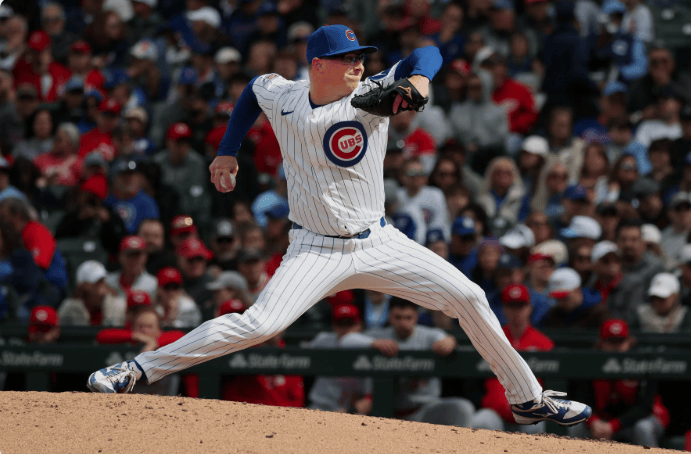
That brings us to Trent Thornton. During the offseason, I highlighted Thornton as the non-roster player the Cubs had picked up who had the most likelihood of having an impact on the major league team.
And Thornton has had a major impact, pitching in 40 games so far, with a 2.38 ERA over 41.2 innings, with 5 holds, 3 saves and only 1 blown save. By all those measures, he’s had an extremely successful season.
But the analytics people, including myself, have been predicting a fall for Thornton for most of the season, specifically because based on his peripheral numbers, he should not be having the season he is having. He was not striking people out (putting his fWAR below zero) and his FIP and expected ERA were much worse than his actual number.
Here are mire dire predictions about Thornton and the rest of the bullpen: https://cubsin7.blog/2026/06/27/is-the-cubs-bullpen-set-to-fall-off-a-cliff/
https://cubsin7.blog/2026/07/15/2nd-half-cubs-predictions/
As the Cubs have gotten back pitchers from injury and potentially needed to DFA someone, I had Thornton in the crosshairs for a while. And yet, here he still is. When Palencia returned, I mentioned 3 names of players who could possibly be DFA’d instead of Assad getting sent down: Aaron Civale, Caleb Thielbar and Thornton. Assad was sent to AAA, and on Sunday, those 3 “DFA candidates” combined to pitch 6 innings of scoreless relief, allowing 1 hit and no walks in a game the Cubs were desperate to win.
I really don’t know what the Cubs will do when Milner and Cabrera come back. They will be able to add a 14th pitcher to the roster on September 1, so that provides one extra spot. But then you have Javier Assad, Ben Brown and possibly Shelby Miller and Justin Steele to add to the mix.
But at this point, I don’t see them removing Trent Thornton from the roster. Sometimes, the stats don’t tell the hole story, and perhaps it has been good luck, but maybe it’s also been a pitcher who has found a way to take advantage of the elite defense of the Cubs to get outs consistently without striking people out, which is something very difficult to measure.
Rather than waiting for Thornton to implode, I could just applaud his successful outcomes.
But something interesting has been happening to Thornton in August His peripheral numbers have actually improved, with a 2.42 FIP and 26.5% K% (up from just under 12% for the rest of the season). Any thoughts that Thornton would be gone if the Cubs make the playoffs are starting to fade.
So, the Cubs are really going to need to be creative if they want to add some of these pitchers coming back from injury, especially with players like Thornton and Civale doing so well. A good problem, I suppose.


Leave a Reply