
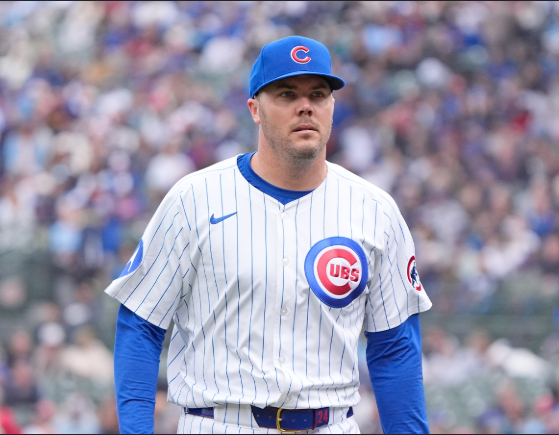
The timing of this post is really bad, as Thielbar gave up the lead last night in a game the Cubs really needed to win. He had been pretty good this season, with a 2.84 ERA going into last night. But a solo homer, a double and a single that brought in the tying run brought his ERA up to 4.05.
But I’ve decided to go with this post anyway, as I’ve gotten a tired of my own negativity.
When looking at Thielbar as a possibly trade candidate, I saw something very interesting. As he gets closer to 40-years-old, his velocity is the best it’s ever been.
Northside Baseball had a post on this, with a good chart showing how Thielbar’s velocity has climbed, year after year:
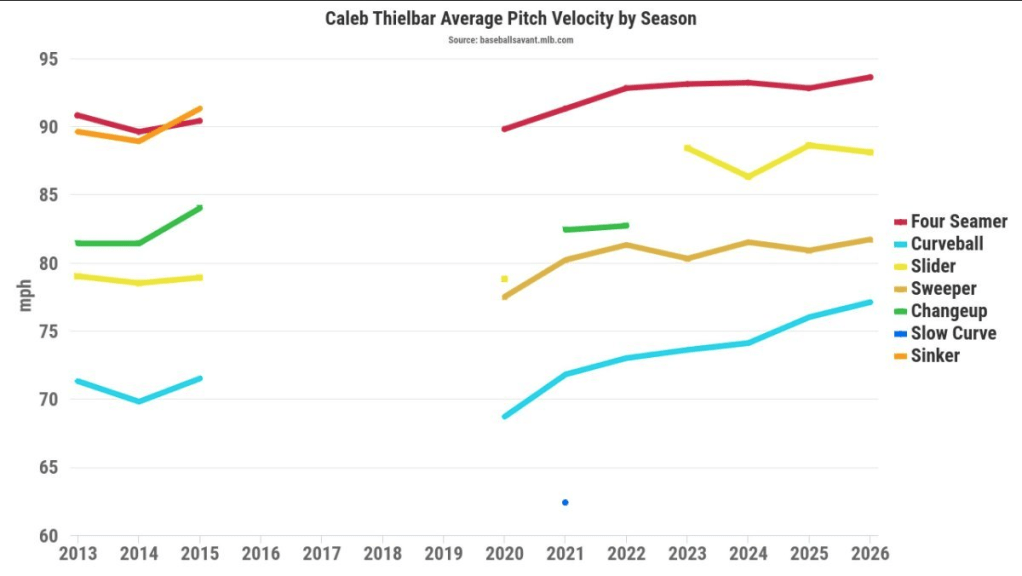
Here is a current chart, showing his pitch velocities year-by-year
| Year | Fourseam | Sinker | Slider | Curve | Changeup |
|---|---|---|---|---|---|
| 2013 | 90.2 | 89.0 | 78.4 | 70.8 | 80.8 |
| 2014 | 89.0 | 88.3 | 82.0 | 69.3 | 80.8 |
| 2015 | 90.0 | 90.7 | 79.0 | 73.3 | 83.4 |
| 2020 | 89.8 | N/A | 77.8 | 68.7 | N/A |
| 2021 | 91.3 | N/A | 80.2 | 71.8 | 82.4 |
| 2022 | 92.8 | N/A | 81.3 | 73.0 | 82.7 |
| 2023 | 93.1 | N/A | 82.0 | 73.6 | N/A |
| 2024 | 93.2 | N/A | 81.6 | 74.1 | N/A |
| 2025 | 92.8 | N/A | 84.6 | 76.0 | N/A |
| 2026 | 93.4 | N/A | 85.8 | 76.9 | N/A |
There are obviously some very interesting things in this chart:
- There is a noticeable gap in his career, as he was released by the Twins in 2015, played with the Padres AAA team and was released again, played in the independent league in 2016 and 2017, was in the Tigers and Braves minor leagues in 2018 and 2019, and went back to the Twins in 2020.
- He has abandoned two pitches over the course of his career: his sinker after 2015 and his changeup after 2022. He also threw one knuckle curve in 2021.
So while almost all other pitchers lose velocity over the course of their career, how has Thielbar been able to move in the other direction?
While I can’t find a specific article about Thielbar’s resurgence, there appear to be a couple of main factors
Some other pitchers cited as having similar career paths are Jacob DeGrom, Justin Verlander, Charlie Morton, Randy Johnson and Aroldis Chapman. Although none of them reached peak four-seam velocity in their 39-year of life.
- DeGrom peaked at age 33 (at 99.2, up from 93.5)
- Verlander peaked at 95.6 when he was 26, but got back up to 95 (from until 91.8) he was 37
- Morton peaked at 96.1 (up from 91.5) when he was 34, but has stayed at 94-95 since, and is now 42-years-old. Although, he’s been hurt this year.
- Fangraphs does not have pitch-type splits going back past 2008, so it is impossible to say exactly when Randy Johnson’s velocity peaked, but he certainly maintained it late into his career. However, he was down to 90.1 on his fastball when he was 45.
- Chapman’s two-seamer is actually faster than his four-seamer since 2018, averaging over 100 mph for 6-straight seasons. But he hit his peak of 101.1 at 35-years-old, and is now down to 98 as an average.
So while several pitchers have seen increased velocity late in there careers, most peaked around their mid-30s.
Now just because his velocity is higher, it does not mean Thielbar is pitching better, as spin and location are other major factors. But the spin rate on his curveball is at 2598, slightly down from his career high of 2607 last season.
He has seem some variance in the horizontal and vertical break of his pitches, with the horizonal break on his slider dropping considerably this season, which might be a result of the increased velocity. It will be interesting to see if this trend continues throughout 2026.
I’m sure we will see this velocity gain reverse itself if Thielbar decided to keep pitching into his 40s, but he has certainly defied the normal wear and tear of age so far.
 Cubs in 7
Leave a comment