
A couple of days ago, it looked like the Cubs versus Reds might be a battle between two teams tied for first in the NL Central. But after the Cubs swept the DBacks and the Pirates swept the Reds, the Cubs lead is now 2 games.
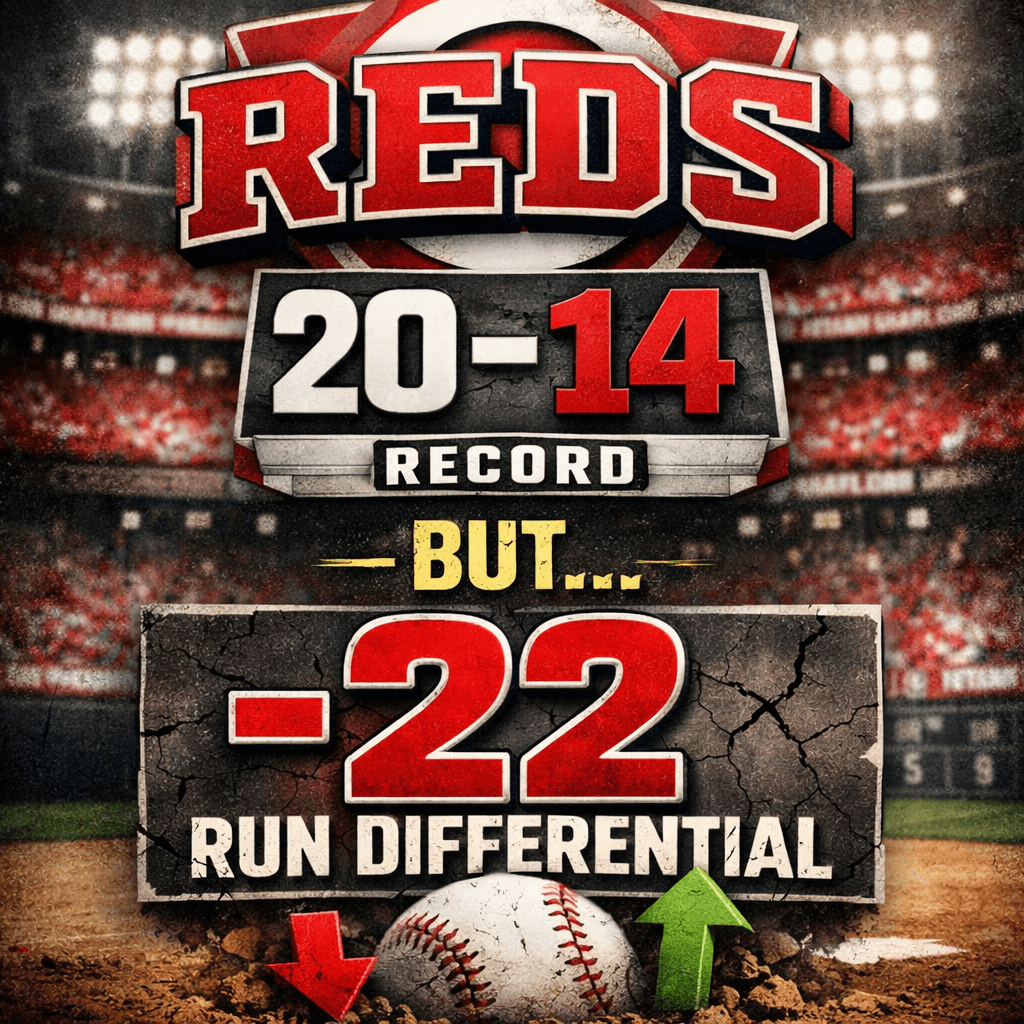
Still, Cincinnati has followed their Wild Card season with a very good start, despite the absence of Hunter Greene. Currently, they are 20-14. for a .588 win percentage. And they had done this despite a very poor run differential, which currently stands at -22.
Based on this poor run differential, the expected W-L based on the Pythagorean formula would be 15-19 for a .432 win percentage. That +5 game swing is currently the largest in baseball, with the Rays and Padres not far behind at +4.
So how had the Reds done it? There are a few easy answers:
- They are 7-1 in 1-run games – and were undefeated before yesterday’s 1-0 loss.
- They are 3-0 in extra innings games
- They Have lost 9 blowout games (5+ run difference) versus winning 5 blowout games.
Can the Reds sustain this good luck continue, or will the crash down to reality?
If we look at the past, the odds are probably against them sustaining the difference between actual record and expected record. But there are plenty of examples of teams that outperformed their expected win percentage, and other teams that underperformed.
Last season, several teams performed as expected, with the Yankees, Brewers, Cubs, Dodgers, Phillies, Red Sox, Mariners, Padres, Tigers and Blue Jays all in the top 11 of teams for expected records, and all made the playoffs. With a -6 run differential, the Guardians were the surprise team, at a +8 wins versus expected, winning the AL Central. And the Reds snuck into the playoffs despite only 85 expected wins. The big losers were the Mets, who were +51, and should have finished a game above the Reds for the final Wild Card. And the Rangers should have won the AL West, with a +79 run difference, but won 9 fewer games than expected.
But the last teams before the Guardians with a negative run differential to make the playoffs were the Diamondbacks (-15) and Marlins (-57!) in 2023. The Cubs and Padres should have made the playoffs that year, but were -8 and -10 wins below expected, respectively. Amazingly, the Marlins were 33-14 in 1-run games. so, the possibility that the Reds could sustain this run of success in close games in not out of the question.
However, the increase is playoff teams is part of the reason we’ve seen 3 playoff teams in the past 3 years with negative run differentials make the playoffs. If we exclude the shortened seasons of 2020 and 1981, only 5 other teams in MLB history had made the playoffs with a negative run differential:
- 2007 Diamondbacks, -20 run differential, +11 wins over expected
- 2005 Padres, -42, +5
- 1997 Giants, -9, +10
- 1987 Twins, -20, +6
- 1984 Royals, -13, +4
Cubs fans may remember the 2007 Diamondbacks, who despite their unlikely trip to the playoffs, swept the Lou Pinella-managed Cubs in 3 games. And for older fans out there, the 1987 Twins were notable for a rousing World Series victory against the St. Louis Cardinals.
Ben Clemens wrote an interesting article for Fangraphs about the potential predictive nature of the Pythagorean model, and found that it was better than record or chance, but not that much better. But if blowouts were removed, game by game, that would be slightly more accurate than just overall run differential.
To looks at this season, which is a small sample size, I tried to created some adjusted run differentials to remove the impact of those blowouts.
I chose 3 teams in the NL Central: The Reds, who have overperformed run differential, the Cubs who have performed accurately, and the Brewers, who have underperformed.
I decided to take all 5+ run losses and wins and treat them as exactly 5 run losses and wins. Then I did a second adjustment, bringing down to +4 and -4 for all blowouts.
| Team | Run Diff | Adj Diff 1 (5) | Adj Diff 2 |
|---|---|---|---|
| Reds | -22 | -6 | -2 |
| Cubs | 42 | 35 | 31 |
| Brewers | 45 | 23 | 18 |
What this tells me is that the Reds run differential is significantly impacted by their blowout losses and the Brewers by their blowout wins. Meanwhile, the Cubs run difference is not as impacted, meaning their differential has been more evenly impacted by blowouts both for and against.
So, if we normalize some of the outlier blowouts, it would appear to mean that the Reds expected record should actually be better than their run differential suggests, and the Brewers expected record should be slightly worse. And the Cubs expected record is pretty accurate.
This is something I’ll need to take a closer look at as the season continues.
 Cubs in 7
Leave a comment