
The Cubs have done quite well over the past few seasons, finding some good players via minor league free agent deals, waiver claims and waiver trades.
2024 brought in Jorge Lopez and Tyson Miller. And 2025 brought in Drew Pomeranz, Chris Flexen, Ryan Brasier, Aaron Civale, and the hidden gem of them all, Brad Keller.
I’ve written ablout the Cubs bullpen in 2025 a few times before: here when talking about how they’ve used DFAs to build depth, and here about them moving to a “Plan C” last season. And here was my overall analysis of the bullpen in 2025.
One of the big questions of the offseason was how the Cubs would account for the massive turnover of the bullpen from 2025 to 2026. They have been very aggressive – perhaps more aggressive than I expected – in bringing in major league arms to fill out the bullpen. This included bringing back Caleb Thielbar and adding Phil Maton, Hunter Harvey, Hoby Milner and Jacob Webb. I expected them to rely a bit more on some of the young, in-house pitchers (Ben Brown, Luke Little, Javier Assad, Jordan Wicks and Porter Hodge, among others) as well as picking up players via minor league deals and waivers.
With the small number of spots that truly feel like they are in competition for the bullpen, it may be less likely we see one of the minor league free agents the Cubs have signed to break through and make the team, but there are a few candidates. These are their stories.
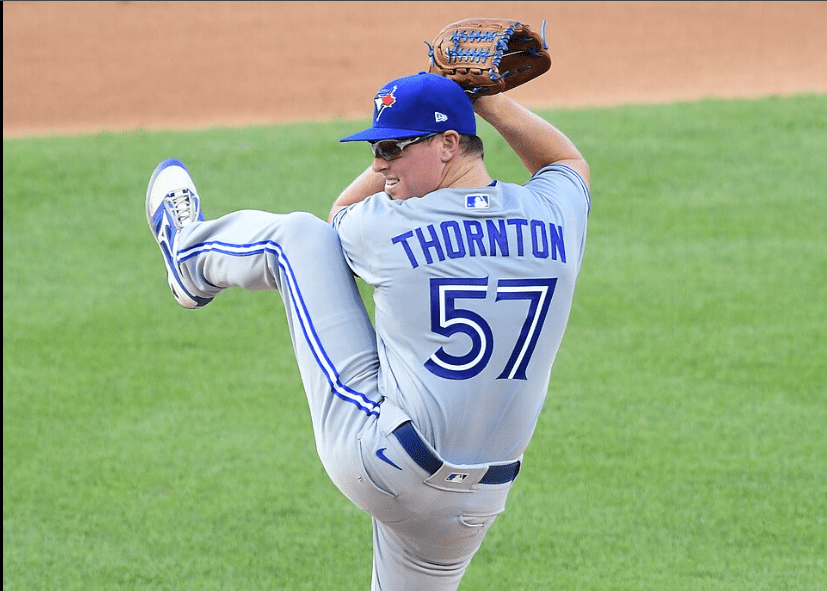
Thornton has a fair amount of MLB experience, pitching in 108 games over seven season in the Majors with the Blue Jays and Mariners. His best year was 2023, when he had a 2.01 ERA over 27 games – despite struggling in the minors. He was solid in 2024, with a 3.61 ERA and 3.41 FIP in 71 games for the Mariners. Last season, he slumped a bit to a 4.68 ERA in 33 games before tearing his achilleas in August to end his season. He was DFA’d by the Mariners in the offseason.
Here is a good summary of Thornton’s signing from Steve Adams at MLB Trade Rumors.
He has a fairly comprehensive repertoire, throwing 7 different pitch types last season. Although, he primarily went with four-seamers, cutters, sliders and curveballs. He relied much more on the slider earlier in his career, and was very successful with it in his two best seasons in the majors (’23 and ’24). He introduced a cutter in 2024, and used it more than the slider last season, with it almost completely replacing his sinker.
| Pitch | 2023 | 2024 | 2025 |
|---|---|---|---|
| Four-seam | .802 OPS (154 pitches) | .799 OPS (228 pitches) | .656 OPS (217 pitches) |
| Slider | .675 OPS (202 pitches) | .553 OPS (592 pitches) | .724 OPS (130 pitches) |
| Cutter | N/A | .708 OPS (50 pitches) | .781 OPS (147 pitches) |
| Curveball | 1.038 OPS (38 pitches) | .808 OPS (136 pitches) | .774 OPS (122 pitches) |
| Sinker | .423 OPS (54 pitches) | 1.019 OPS (108 pitches) | 1.850 OPS (16 pitches) |
Thornton tops out at around 97 mph for his four-seamer, and his average is about 2 to 3 mph lower, which seems fairly normal. His slider has gone from and average velocity of 81.4 to 85.2 back to 80.4 over the past three seasons, which is odd. It would be interesting to know why he went so slider heavy and 2024, and why he was throwing it so much harder than he had in the past – and then why he stopped using it nearly as much last year.
In early 2025, Baseball Prospectus wrote:
“…his nickname should be Taylor Sheridan, because the man is simply everywhere and does everything; he led all Mariners relievers in appearances and innings and has an arsenal of pitches five deep. And like Sheridan’s oeuvre, his season was more acceptable than exceptional, with only his sweeper and slider grading out as plus. That’s enough to keep Thornton steadily employed in middle relief, but as Sheridan could tell him, competency in bulk won’t bring home accolades.”
With his current velocity, if he was able to unlock a few more miles per hour on his fastballs, as Brad Keller did, he would be a definite candidate to break out. But Keller was a huge outlier on that front, and at 32-years-old, Thornton may be past the possibility of a velocity jump.
One other possibility for a breakout was provided by Matthew Trueblood of North Side Baseball: the possibility of developing a kick-change to get out left-handed batters.
While I don’t agree with Trueblood’s conspiracy theory about Thornton holding back during his Pro Day, there is still the possibility he was working on the pitch at Tread Athletics, but it was not ready for prime time. I suppose we’ll have to wait and see this Spring. As far as his splits versus right and left-handed batters, he was actually a slightly reverse splits guy early in his career, but has been much better against righties the past 3 seasons:
| Season | OPS vs LHB | OPS vs RHB |
|---|---|---|
| 2019-2022 | .765 | .811 |
| 2023-2025 | .797 | .640 |
| Career | .777 | .752 |
So, finding a way to improve against left-handed hitters would likely give him a leg up on finding a spot in the bullpen.
2025 was a bad year for Thornton health-wise. In addition to the Achilles injury, he missed a month from an appendicitis, and needed to be taken out of a game at Wrigley in June due to the heat. But he does not have any history of arm troubles, except for a few bouts with elbow inflammation back in 2020.
Of the relievers on non-roster deals, Thornton has the best track record. With his decent fastball and good slider, he might have a chance to make the major league roster. I have no idea what his contract stipulates about when he could ask for his release if he doesn’t make the majors – as it might be directly out of spring or sometime later in the season. Hopefully, they will be able to send him to Iowa for a little while if he can’t make the team immediately, to provide more pitching depth.
 Cubs in 7
Leave a reply to Searching for Brad Keller – a Summary – Cubs in 7 Cancel reply