

A look back at how each position performed in 2025, and a look ahead to 2026. These posts will compare the MLB rankings from 2024 with those produced in 2025, as well as individual statistics for all players who played the position in 2025.
Here are the other entries:
Catcher
First Base
Second Base
Shortstop
Third Base
Positional Rankings: 2025 vs 2024
| Stat | 2024 | 2025 | Change |
|---|---|---|---|
| WAR | 9.8 (6th) | 14.3 (3rd) | +4.5 (+3) |
| HR | 65 (9th) | 89 (3rd) | +24 (+6) |
| RBI | 253 (4th) | 292 (2nd) | +39 (+2) |
| OPS | .747 (7th) | .797 (2nd) | +.050 (+5) |
| wRC+ | 110 (8th) | 122 (2nd) | +12 (+6) |
| DRS | 18 (4th) | 18 (4th) | +0 (+0) |
| OAA | 8 (t7th) | 18 (2nd) | +10 (+5) |
Values are total and then MLB rank in parentheses
wRC+ = Weighted Runs Created Plus
DRS = Defensive Runs Saved
OAA = Outs Above Average
The Cubs outfield was really good in 2024, with top 10 numbers in all the metrics above. But the huge offensive improvement from Pete Crow-Armstrong, and the slight improvement from Seiya Suzuki in 2024 to Kyle Tucker in 2025 moved the Cubs to a top 3 outfield in WAR, behind only the Aaron Judge led Yankees, and the Red Sox, who have a centerfielder who had better defensive numbers in 2025 than PCA.
Meanwhile, Ian Happ continued his very steady play in 2025 that has been the story of his career – and the ire of many Cubs fans on social media.
One of the major benefits of adding Kyle Tucker was that Seiya Suziki was able to be the DH most of the time, which greatly increased the production there. (Editor’s Note: The production at DH for the Cubs actually decreased in 2025).
Individual Stats as a outfielder
| Name | G | WAR | HR | RBI | OPS | wRC+ | DRS | OAA |
|---|---|---|---|---|---|---|---|---|
| Pete Crow-Armstrong | 155 | 5.5 | 31 | 95 | .775 | 111 | 15 | 21 |
| Ian Happ | 146 | 2.8 | 22 | 78 | .765 | 117 | 9 | 0 |
| Kyle Tucker | 115 | 4.4 | 19 | 66 | .866 | 142 | -1 | -2 |
| Seiya Suzuki | 48 | 1.7 | 16 | 45 | .931 | 152 | -5 | 0 |
| Willi Castro | 19 | -0.3 | 0 | 3 | .463 | 43 | 0 | -1 |
| Owen Caissie | 8 | 0.1 | 1 | 4 | .652 | 81 | 0 | 1 |
| Kevin Alcántara | 6 | 0.1 | 0 | 1 | .780 | 129 | 0 | 0 |
| Vidal Bruján | 5 | -0.1 | 0 | 0 | .222 | -36 | 0 | 0 |
The Cubs basically had 4 outfielders who played the majority of the time, with Seiya Suzuki filling in for Kyle Tucker when he was injured.
Pete Crow-Armstrong
Pete Crow Armstrong had the highest WAR, and his offense was a revalation. Unfortunately, opposing pitchers discovered that he lacked plate discipline, and his second half was not nearly as good offensively.
Here are the splits from first half to second half:
| Half | PA | HR | RBI | SB/CS | AVG | OPS | wRC+ |
|---|---|---|---|---|---|---|---|
| 1st Half | 401 | 25 | 71 | 27/4 | .265 | .847 | 131 |
| 2nd Half | 246 | 6 | 24 | 8/4 | .216 | .634 | 72 |
The numbers are a bit skewed, as he had 155 more plate appearances in the “first half”. But his OPS and wRC+ do not lie. A 131 wRC+ over the course of a season would have put him around 25th in all of baseball among qualified players. His 72 in the 2nd half would have put him 143rd, 4th worst among qualified players, and worse than he did in 2024. His running game also took a hit, as he was thrown out the same number of times in the 2nd half, with 19 fewer successful steals in the 2nd half – although a couple of those could be attributed to over-sliding 2nd base.
His poor second half numbers, combined with his anemic playoff performance (.185/.214/.185 slash line with 0 HR and a 41.1 K%) poured cold water on what was otherwise a breakout season.
Crow-Armstrongs’s lack of plate discipline is no secret, but how bad is it?
- 41.9% O-Swing% (pitches swung at outside the strike zone) – 3rd worst among 145 qualified hitters (Kyle Tucker was 3rd best at 18.3%)
- 78.8% Z-Swing% (pitches swung at inside the strike zone) – 2nd in MLB
- 59.5% Swing % (swing rate for all pitches) – Tied for 1st in MLB
- 73.3% Contact% (percentage of contact rate when swinging at all pitches)
Can Crow-Armstrong improve on this, and if he could, how would that impact his overall numbers?
As we all remember, Javy Baez was a free swinger with the Cubs, and he really has not gotten much better. If we look at some of worst hitters over the course of the years, let’s see if there was much improvement – specifically looking for better MLB hitters.
Rafael Devers: 38.5% in 2020, 25.2% in 2025
Bo Bichette: 38.7% in 2021, 33.8% in 2025
Jeremy Pena: 37.5 in 2022, 35.4% in 2025
Ezequiel Tovar: 43.0% in 2023, 39.9% in 2025
Ceddanne Rafaela 46.3% in 2024, 41.4% in 2025
So, some minor improvements do seem possible, with only Devers showing major improvements.
Meanwhile, some players always seems to show up on the top of the list over the past 10 years: Jose Iglasias, Tim Anderson, Javy Baez, Eddie Rosario and Nick Castellanos to name a few. The unfortunate truth is that none of these players got better late in their careers.
Here are the year-over-year number for the top 10 in 2024 – to see how much improvement could occur in one year:
| Name | 2024 O-Swing% | 2025 O-Swing% | Diff |
|---|---|---|---|
| Ceddanne Rafaela | 46.3% | 41.4% | 4.9% |
| Ezequiel Tovar | 44.8% | 39.9% | 4.9% |
| Salvador Perez | 42.6% | 40.1% | 2.5% |
| Yainer Diaz | 42.3% | 43.8% | -1.5% |
| Jesús Sánchez | 38.8% | 31.3% | 7.5% |
| Nick Castellanos | 37.7% | 40.6% | -2.9% |
| Jose Altuve | 37.5% | 38.1% | -0.6% |
| Jeremy Peña | 37.0% | 35.4% | 1.6% |
| Ryan Mountcastle | 36.9% | 38.3% | -1.4% |
| Alec Burleson | 36.7% | 31.3% | 5.4% |
At 41.3%, PCA would have been on this list if he had enough at bats last season. So he actually saw a little bit of regression in 2025.
But even if PCA improved his plate discipline in 2026, would it improve his offense overall? For the 4 players in the bottom 10 in 2024 who improved by nearly 5% or more, here was their wRC+ for each season:
| Name | Discipline Improvement | 2024 wRC+ | 2025 wRC+ |
|---|---|---|---|
| Ceddanne Rafaela | 4.9% | 81 | 91 |
| Ezequiel Tovar | 4.9% | 94 | 78 |
| Jesús Sánchez | 7.5% | 101 | 93 |
| Alec Burleson | 5.4% | 106 | 124 |
So, nothing conclusive here. But these are all small sample sizes, and a lot more analysis would be needed to determine whether improving plate discipline is really possible and whether that would have any correlation on overall performance. I think the realistic hope is that PCA could be a more effective free swinger in 2026, like Sal Perez or Jose Altuve.
Part of this would include maintaining the power numbers he showed in 2025. I was hoping he couple evolve to a 20-home runs a-year hitter, and his home runs actually jumped from 10 to 31. This is probably due to increases in his fly ball % (42.5% to 49.7%) his hard hit % (25.3% to 31.5%) and his pull % (43.5% to 52.9%).
But going back to plate discipline, here is a heat map of PCA’s Slugging percentage based on the location of the pitch:
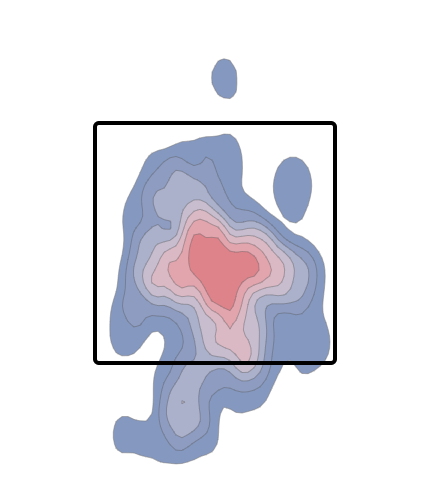
Unsurprisingly, his slugging came from pitches in the middle of the zone — which were basically mistakes by the pitcher. When pitchers know he will swing at anything, they will keep everything out of the strike zone. And against better teams, with better pitching, the situation only gets worse.
Enough of the negatives regarding Crow-Armstrong. The biggest positive he had, which should be enough to sustain him in the majors for years, regardless of his hitting, is his defense. He will win the Gold Glove in the NL, although fellow free swinger, Ceddanne Rafaela of the Red Sox, actually had a better season, and will win the AL Gold Glove. But those two were head and shoulders above all other outfields defensively if you combine Defensive Runs Saved and Outs Above Average. Here were the top 10 MLB Outfielders in 2025, if you combine those numbers:
| # | Name | Team | DRS | OAA | DRS+OAA |
|---|---|---|---|---|---|
| 1 | Ceddanne Rafaela | BOS | 20 | 22 | 42 |
| 2 | Pete Crow-Armstrong | CHC | 15 | 21 | 36 |
| 3 | Victor Scott II | STL | 12 | 17 | 29 |
| 4 | Jacob Young | WSN | 13 | 14 | 27 |
| 5 | Myles Straw | TOR | 18 | 9 | 27 |
| 6 | Steven Kwan | CLE | 22 | 5 | 27 |
| 7 | Wyatt Langford | TEX | 16 | 10 | 26 |
| 8 | Fernando Tatis Jr. | SDP | 15 | 8 | 23 |
| 9 | Wilyer Abreu | BOS | 15 | 8 | 23 |
| 10 | Kyle Isbel | KCR | 9 | 12 | 21 |
Kyle Tucker
Like it or not, thoughts about Kyle Tucker will also revolve around the price it took to get him. Issac Parades was supposed to finally solve the Cubs’ third base problems and Cam Smith was a quickly rising star in the farm system And Hayden Wesneski was a pitcher who sill seemed to have potential.
But I, for one, was all about getting Tucker this past offseason:
https://cubsin7.blog/2024/12/13/tucker-or-bust/
When Cam Smith made the Astros opening day roster, the pressure seemed even higher for Tucker to succeed. And there was a thought that having him on the roster might make it easier to sign him to an extension before he hit free agency.
Here are Tucker’s numbers month-by-month:
| Monthly | PA | HR | RBI | OBP | SLG | OPS | BABIP | Hard% | wRC+ |
|---|---|---|---|---|---|---|---|---|---|
| Mar/Apr | 145 | 7 | 27 | .386 | .549 | .935 | .276 | 33.3% | 156 |
| May | 121 | 5 | 12 | .397 | .485 | .882 | .289 | 35.2% | 144 |
| Jun | 104 | 5 | 13 | .404 | .578 | .982 | .354 | 34.3% | 172 |
| Jul | 102 | 1 | 9 | .380 | .295 | .675 | .239 | 27.9% | 105 |
| Aug | 104 | 3 | 9 | .346 | .389 | .735 | .292 | 36.2% | 112 |
| Sept/Oct | 20 | 1 | 3 | .200 | .316 | .516 | .133 | 18.8% | 41 |
Everything seemed on track early in the season. The good run continued through May, but there was some concern when Tucker missed a game after hurting his hand on a slide early in June. But that turned out to be his strongest month offensively.
And then came July, when the bottom fell out for Tucker and much of the Cubs offense. Tucker’s slugging and hard hit % nosedived, several other Cubs went into slumps, and the Brewers went on a historic run to take over first place in the Central Division. He did manage to keep getting on base, taking lots of walks in July.
There was lots of speculation around the slump, much of it blaming the finger injury Tucker had suffered in early June, and Cubs management took lots of criticism.
I wrote about the timeline of his injury, his slump, and how we all found out that he had broken his finger: https://cubsin7.blog/2025/08/21/the-strange-case-of-kyle-tucker-and-the-broken-hand/
Tucker continued to struggle, and was finally given a few days off on August 19th and 20th. He had a nice stretch at the end of August, hitting a few home runs, and looking like he might have a strong finish to the season.
And then he tweaked his calf. It was an odd injury, starting as something that was supposed to be day-to-day, but he finally ended up on the IL, and only returned for the last few days of the regular season, doing very little at the plate in September.
He was a bit better in the postseason (slashing .273/.375/.370), but fans last memories of Tucker as a Cubs will be from his last two at bats in the deciding Game five of the NLDS against the Brewers: a strikeout with 2 on and nobody out in the 6th, and a rollover to first as the tying run in the 8th with 2 outs.
So what do we make of his season? He played in 136 games, about 50 more than he played in 2024. Among qualified players, he was 24th in OPS, and 16th in wRC+. Considering his poor 2nd half of the season, they are still very strong numbers, and will get him a big contract this offseason.
One question mark about Tucker in 2025 was his defense. He replaced Suzuki in right field, and was better from a DRS perspective. But he definitely did not look like a former gold glove player. Let’s look at his career defensive numbers in right field:
| Season | Inn | Assist | DRS | OAA | RngR | UZR | FRV |
|---|---|---|---|---|---|---|---|
| 2018 | 16.0 | 1 | 0 | 1 | 0.0 | 0.5 | 1 |
| 2019 | 58.0 | 1 | 4 | 2 | 1.3 | 1.4 | 2 |
| 2020 | 50.1 | 1 | 2 | 0 | 0.2 | -0.5 | 0 |
| 2021 | 1129.0 | 6 | 6 | 2 | 4.1 | 0.4 | 0 |
| 2022 | 1276.1 | 8 | 15 | 4 | -0.9 | 3.0 | 8 |
| 2023 | 1323.1 | 8 | 2 | -4 | 1.3 | -1.1 | -4 |
| 2024 | 592.2 | 4 | 7 | 2 | 2.2 | 4.2 | 2 |
| 2025 | 1001.2 | 5 | -1 | -2 | * | * | 2 |
RngR and UZR are not yet available for 2025
RngR = Range runs above average
UZR = Ultimate Zone Rating
FRV = Fielding Run Value
His defensive runs saved in 2022, when he won a gold glove seems like an outlier. But he also did well in 2024, in limited innings. It is curious that his Range Rating in his Gold Glove year was worse than any of his other seasons. I think this shows that defensive ratings are still very confusing and sometimes conflicting. While the gold glove voters are now looking at advanced starts, I think they may be focusing on Defensive Runs Saved and Outs Above Average.
Ian Happ
The Cub who seems to take the most criticism on social media is also the longest tenured Cubs, Ian Happ. And those two facts are probably related. Happ is solid, but not spectacular, providing value as a good defender, but lacking the spectacular highlight reel of someone like PCA. His poor playoff numbers this year added fuel to the “trade Happ” sentiment, although with a full no-trade clause, he won’t be going anywhere in 2026.
In the last 4 seasons, Happ has WARs of 3.7, 3.2, 3.6 and 2.8. Certainly not superstar numbers, but very solid year after year.
Let’s take a look at Happ’s value versus his salary compared to other left-fielders from 2022 to 2025. We’ll filter out young players, such as Steven Kwan, Jerran Duran, Taylor Ward and Yordan Alverez who were on their pre-arbitration contracts, and provide the most value.
| # | Name | Team | WAR | Dol | Salary | Diff |
|---|---|---|---|---|---|---|
| 1 | Brandon Nimmo | NYM | 15.4 | $123.3M | $66.5M | $56.8M |
| 2 | Ian Happ | CHC | 13.3 | $106.7M | $59.7M | $47M |
| 3 | Bryan Reynolds | PIT | 8.3 | $66.3M | $36.25M | $30.05M |
| 4 | Jurickson Profar | 3 Tms | 6.5 | $52.20M | $2.975M | $22.45M |
| 5 | Kyle Schwarber | PHI | 11.4 | $91.0M | $83M | $8M |
| 6 | Christian Yelich | MIL | 11.4 | $91.6M | $104M | -$12.4M |
Dol = War value converted into dollars
Salary = Actual Salary and Buyout dollars 2022-2025
Diff = Dol – Salary
So, in this group of veteran left-fielders, only Brandon Nimmo has provided more value based on his salary. I’m guessing many Cubs fans would have greatly preferred any of those other names to Happ. It also servers as a bit of a warning around spending too much on offense-only players, such as Kyle Schwarber. It also highlights the value of developing and keeping young players, as their early success allows a team to spend in other areas.
Happ has also been willing to try to fill the leadoff role over his career with the Cubs. He’s has decent on-base number through his career, especially when compared to the rest of the team. But he fid not do as well at leadoff in 2025 as he did in other spots in the batting order, which has also been true over his career.
Here are Happ’s Career numbers:
| Batting Order | PA | AVG | OBP | SLG | OPS |
|---|---|---|---|---|---|
| Batting 1st | 1078 | .234 | .332 | .409 | .741 |
| Not 1st | 3371 | .251 | .346 | .459 | .805 |
And here are the same numbers for 2025
| Batting Order | PA | AVG | OBP | SLG | OPS |
|---|---|---|---|---|---|
| Batting 1st | 394 | .224 | .322 | .374 | .696 |
| Not 1st | 229 | .270 | .371 | .489 | .860 |
I have no explanation for these numbers. It seems quite odd that placement in the batting order would have that much of an impact on player performance. For Happ in 2025, it may simply have been coincidence that his hot streak — which seems to happen every season — coincided with his move out of the top spot in the order. Or, it could also be that he was moved out of the top spot due to a slump, and was not in the leadoff spot when he broke out of it.
Or is it possible that there is some mental bock with leading off for Happ? Regardless, it would seem like a good idea to hit him further down in the order in 2026.
Happ continues to prove his value defensively, as he’s a Gold Glove finalist again, with 5 outfield assists and 9 Defensive Runs Saved. As a left field, his DRS puts him first in the NL over Tommy Pham (5) and Brandon Nimmo (4). Kyle Stowers, the other nominee in left field only had 2 DRS and a -1 OAA.
Seiya Suzuki
I’ll cover Suzuki more in the Designated Hitter post, but I did want to take a look at his defense, as he might be back in right field for the Cubs next season.
| Season | G | E | Assists | DRS | OAA | FRV |
|---|---|---|---|---|---|---|
| 2022 | 106 | 4 | 3 | -4 | -3 | -3 |
| 2023 | 132 | 3 | 2 | 1 | 1 | -2 |
| 2024 | 72 | 3 | 5 | 3 | -3 | -3 |
| 2025 | 32 | 3 | 0 | -4 | 0 | -1 |
The number are not good. It’s possible that his lack of playing time might have contributed, but a -4 DRS in only 32 games in right field is very poor.
2026 Outlook
| Player | 2026 Contract |
|---|---|
| Ian Happ | $19M in 2026 (FA in 2027) |
| Seiya Suzuki | $19M in 2026 (FA in 2027) |
| Pete Crow-Armstrong | $820K in 2026 (pre-arbitration) |
| Kevin Alcantara | $820K in 2026 (pre-arbitration) |
| Owen Caissie | $820K in 2026 (pre-arbitration) |
Ian Happ will be in left and Pete Crow-Armstrong will be in Center next season. Those spots are locked in. So, the only questions are right field and outfield depth.
According to Sportrac, Kyle Tucker is worth about $40M per season, and I’d guess he’d get a contact. There could be a lower AAV if it stretches out over more seasons (such as Vlad Guerrero Jr.’s 14-year deal. There have to be concerns about his injuries the last two seasons, but I would guess one of the big spenders will sign him. to a long-term deal, with lots of deferred money. The impending lockout might impact things, but he’s definitely the best hitter going on the market this offseason.
And the bottom line is that I would be absolutely shocked if the Cubs brought him back. He only made about $16 million for the Cubs in 2025, so re-signing him would cause the payroll to jump, which is not something the Cubs have been willing to do over the past few years.
But with Suzuki’s defensive numbers, I doubt he will play in right field every day. A combination of Caissie and Alcantara would be much better defensively, but I’m not sure the Cubs would carry two additional outfielders. Perhaps the go with a combination of Caissie, Suzuki and Ballesteros for Right Field and DH, but that leaves them with no backup in Center behind PCA.
A guy like Willi Castro, who can play infield and outfield would actually be a great fit, but I’m guessing he’d be looking for a starting spot somewhere. And his poor play with the Cubs may have soured any possibility of him coming back.
There is always the chance for a trade to bring a more proven hitter into the fold, but that is much more difficult to speculate about.
 Cubs in 7
Leave a reply to Cubs Offseason Position Review: Relief Pitcher – Cubs in 7 Cancel reply