
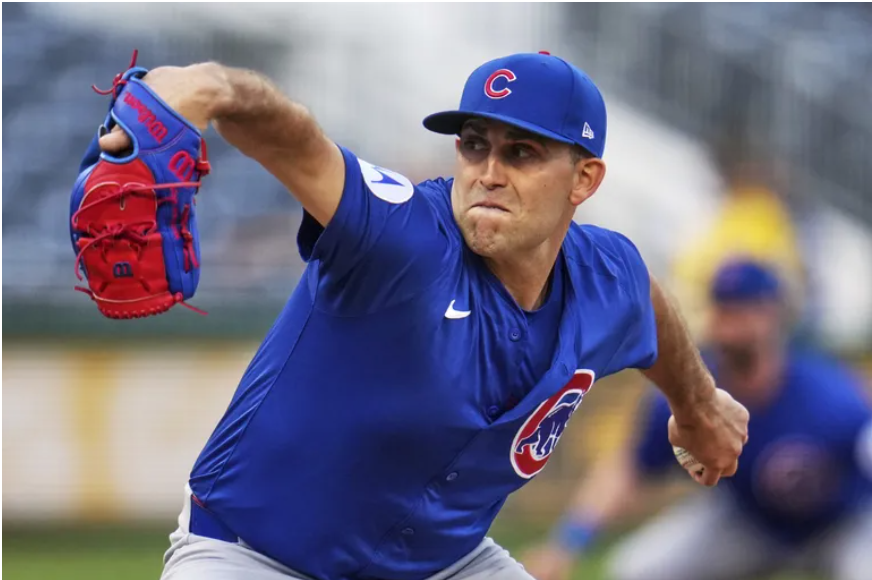
About 2 months ago, if you had offered me the scenario that the Cubs would be in the Division Series, down 2 games to 1, with Matthew Boyd as the starter, I would have gladly accepted it. But if you base the current evaluation of the scenario based on Cubs Social Media, this is the worst thing that has happened in the history of the Universe.
And while I’m not as knee-jerk as most people on Twitter, I am still feeling very uneasy about having Boyd on the mound tonight.
So, why are we so down on Boyd? The primary reason was his performance in Game 1 of the series. But it was also a trend over the 2nd half of the season. Here are the 1st half vs 2nd half splits:
| Season | Monthly | IP | ERA | H | ER | HR | BB | SO | AVG | OBP | SLG |
|---|---|---|---|---|---|---|---|---|---|---|---|
| 2025 | 1st Half | 111.2 | 2.34 | 92 | 29 | 10 | 23 | 102 | .227 | .274 | .347 |
| 2025 | 2nd Half | 68.0 | 4.63 | 62 | 35 | 9 | 19 | 52 | .248 | .309 | .404 |
And here are month by month advanced pitching stats:
| Month | IP | K/9 | K/BB | HR/9 | K% | WHIP | FIP | xFIP |
|---|---|---|---|---|---|---|---|---|
| Mar/Apr | 33.1 | 8.1 | 2.3 | 0.8 | 20.7% | 1.44 | 3.86 | 4.63 |
| May | 28.0 | 10.9 | 17.0 | 1.3 | 30.4% | 1.04 | 3.10 | 3.12 |
| Jun | 30.1 | 5.3 | 3.0 | 0.9 | 16.2% | 0.79 | 3.83 | 4.58 |
| Jul | 32.0 | 7.9 | 3.5 | 0.3 | 23.0% | 0.94 | 2.54 | 3.68 |
| Aug | 35.2 | 8.1 | 4.0 | 1.0 | 22.5% | 1.09 | 3.56 | 4.17 |
| Sept/Oct | 20.1 | 5.3 | 2.4 | 1.8 | 14.0% | 1.28 | 5.69 | 5.49 |
After a great July, the numbers got worse in August and cratered in September, with his ability to strike out hitters dropping.
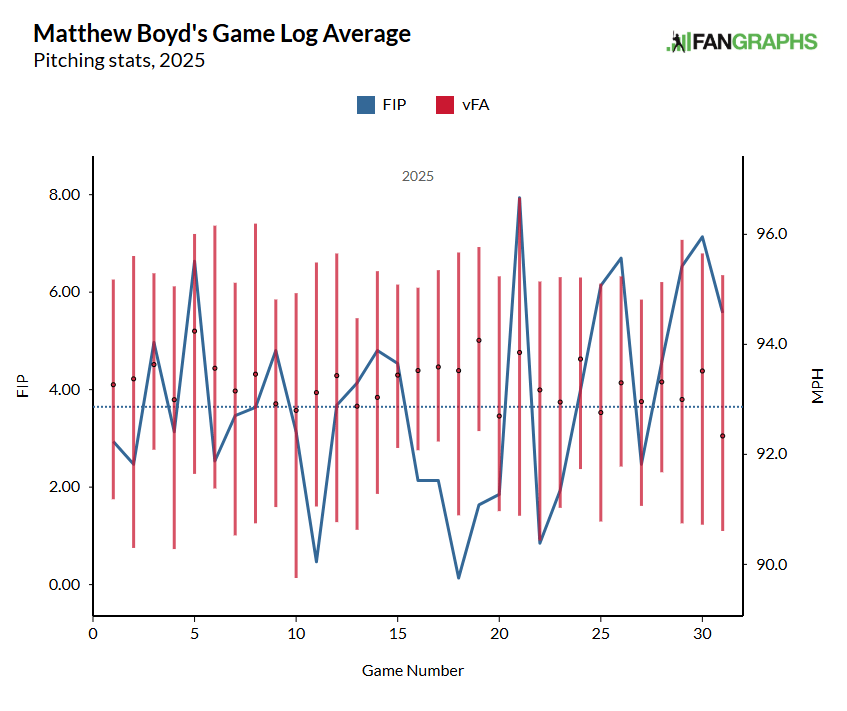
It does not appear to be a velocity issue, as that has stayed steady throughout the year, while his FIP was very high in 5 of his last 6 regular season starts.
Als, his numbers against Milwaukee have not been good at all this season
| Date | IP | H | R | ER | HR | BB | SO | FIP | xFIP | GSv2 |
|---|---|---|---|---|---|---|---|---|---|---|
| 10-4 | 0.2 | 4 | 6 | 2 | 0 | 1 | 1 | 4.64 | 4.64 | 28 |
| 8-19 | 5.1 | 6 | 4 | 4 | 1 | 3 | 3 | 6.14 | 6.88 | 39 |
| 7-28 | 5 | 6 | 5 | 5 | 1 | 5 | 2 | 7.94 | 7.49 | 29 |
Batter by Batter in NLDS Game 1
Here is how Boyd pitched in Game 1
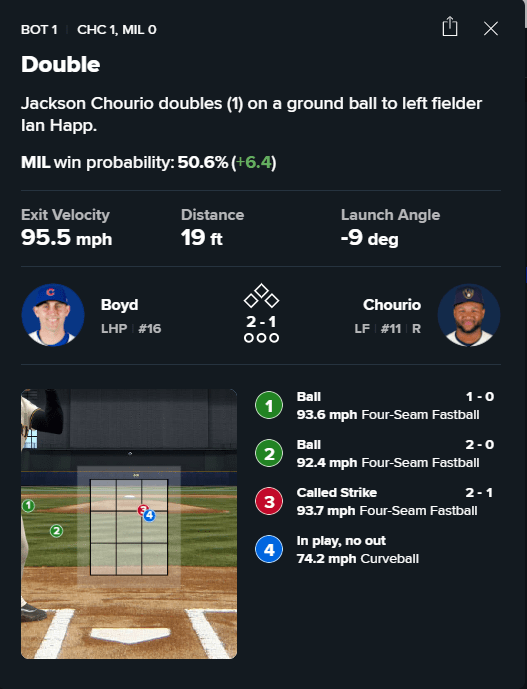
Chourio got two non-competitive fastballs inside before Boyd put two pitches in the same spot, including a curveball that Chourio lined for a double.
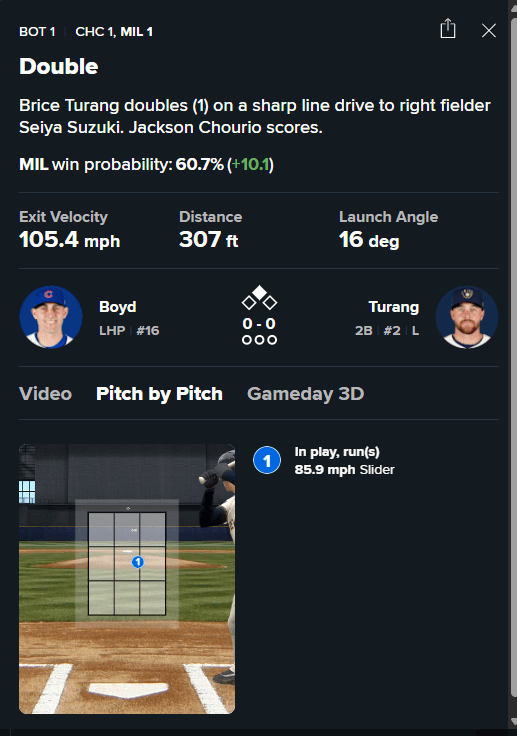
Boyd hung a slider down the middle on pitch 1 to Turang, and he mashed a pitch at 105.4 MPH to tie the score.
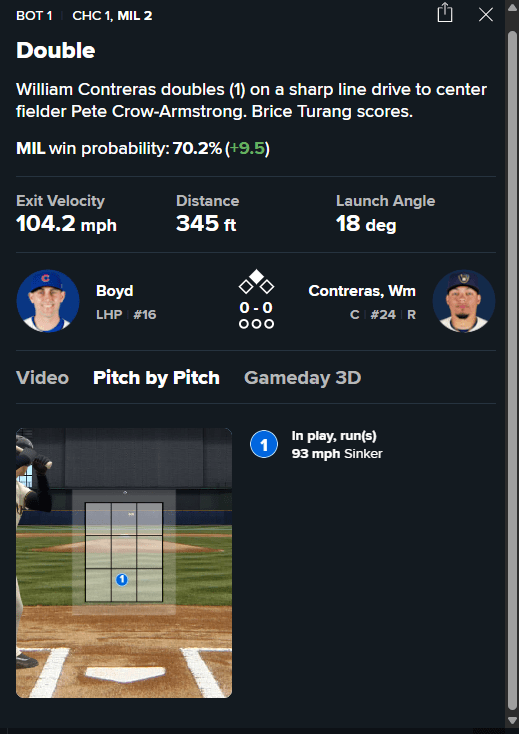
Contreras also blitzed Boyd, smashing a third straight double at 104 MPH off a sinker that caught way too much of the zone.
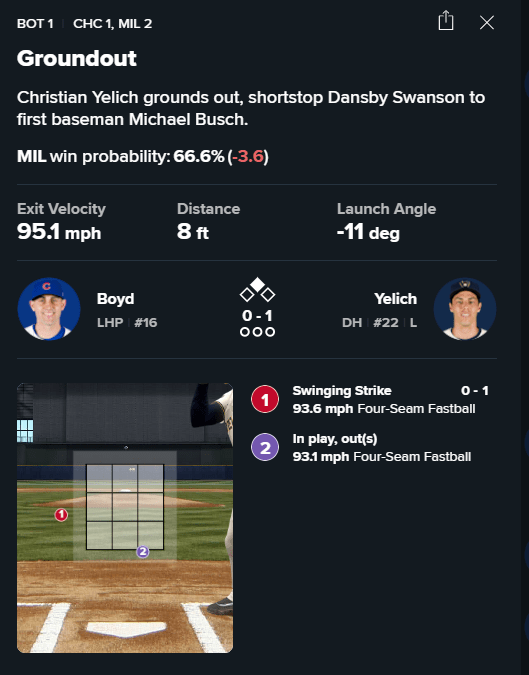
Boyd pitched Yelich well, getting a swing and miss on a pitch out of the strike zone, and then got him to ground out on a pitch low in the zone.
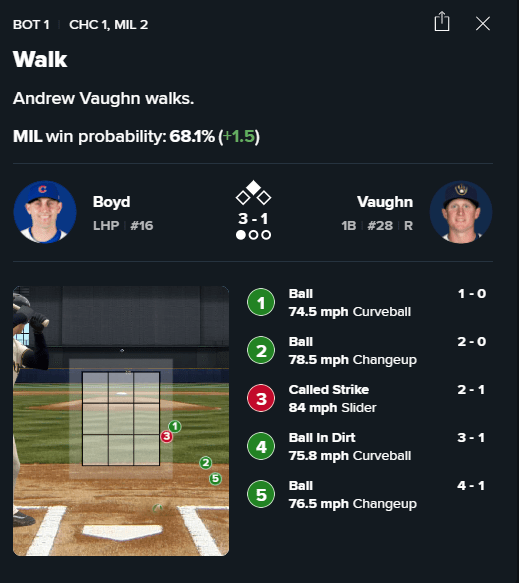
Boyd seemed to want nothing to do with Vaughn, as he stayed far away from him with breaking pitches, only one of which barely touching the zone.
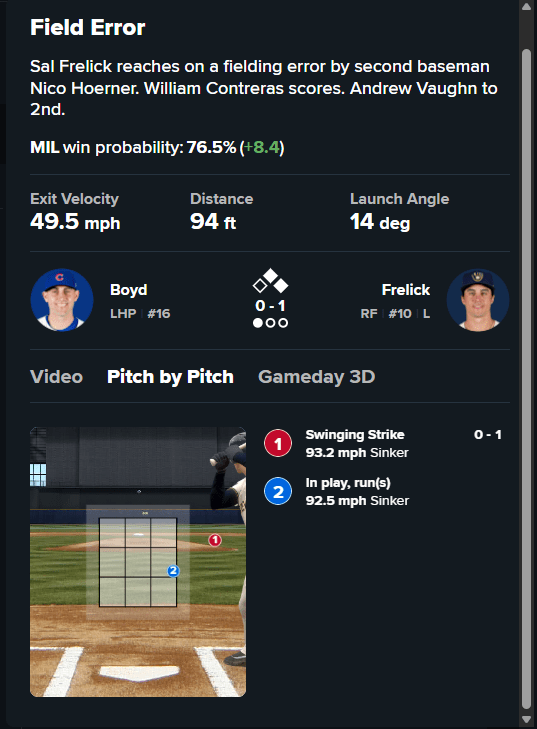
The really big play in the inning, as Boyd might have limited the Brewers to 1 run if Nico Hoerner had made this play. He got soft contact on a sinker on the inside corner, which should have resulted in an out a first, with the other runners moving up. Instead, Contreras scored from second, and the other runners were safe.
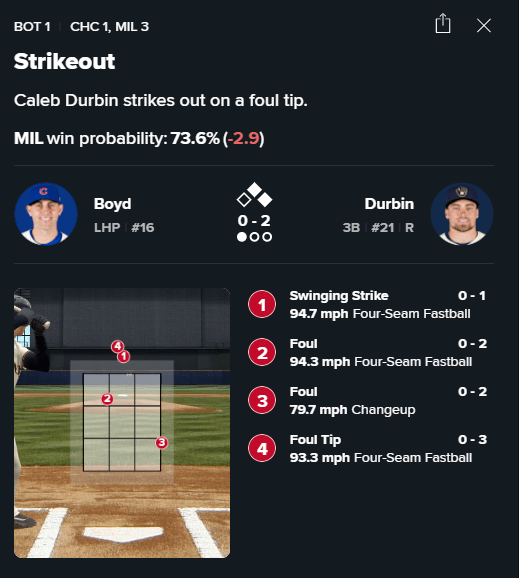
In what should have been the last out of the inning, Caleb Durbin missed a hittable fastball on pitch 2, but Boyd put the other pitches in very good spots.
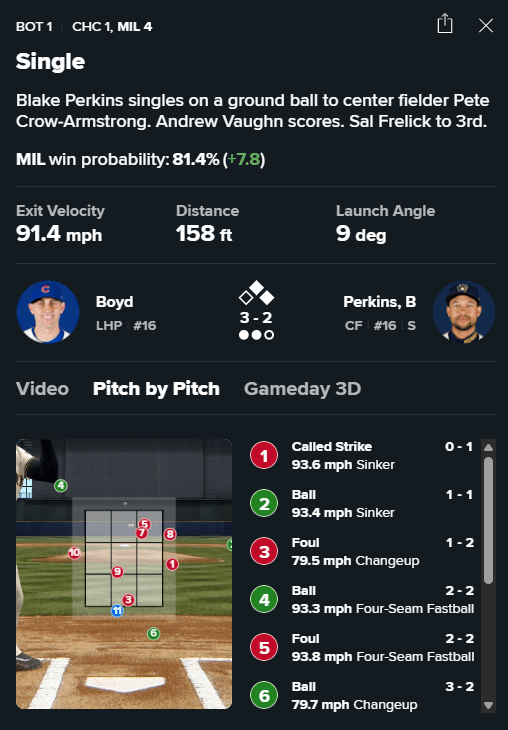
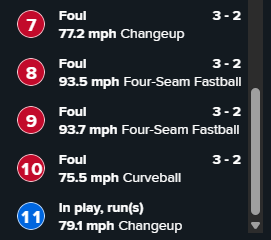
This was just a great at bat from Perkins, fouling off every pitch inside or just barely outside the strike zone, before getting a single on a changeup at the bottom of the zone. If pitch 4 or 6 had been a bit closer to the zone, perhaps Boyd could have gotten an out, but it did not happen. The biggest issue this at bat may have raised is that Boyd was unable to finish Perkins off with how his stuff is playing right now. After the Perkins at bat, he was pulled for Michael Soroka, and 2 more runs came in on a single by Chourio.
What to look for in Game 4
The 3 pitches to the first 3 hitters in Game 1 got too much of the plate. The Brewers were not typically first pitch swingers, but both Turang and Contreras were really aggressive, hammering first pitch strikes. Boyd may have thought he could get ahead in the count, but the Brewers seemed ready for this.
Who knows what will happen in game 4, as the Brewers might decide to go back to their patient ways. Regardless, Boyd needs to be more careful with first pitches. If he is unable to stay on the fringes of the strike zone, if might be another long night.
It will also be important to see how many non-competitive pitches he throws. There were too many in the at bats to Chourio, Vaughn and Perkins, helping lead to 2 hits and a walk. With a fastball maxing out around 95, Boyd will need to get more swings and misses on pitches out of the strike zone, but that look good enough to get the batters to swing.
As this is an elimination game, I’d expect Counsell to give an even shorter leash for Boyd – if that’s even possible – with Rea, Soroka or Civale ready in the pen, even if they need to enter in the 1st inning again. I was hoping the Brewers might start a right-hand centric lineup, leading to pinch hitters if Boyd is pulled, but in Game 1, the only hitter they removed was Andrew Vaughn (for Bauers) after Boyd was pulled.
 Cubs in 7
Leave a reply to Cubs Offseason Position Review: Starting Pitcher – Cubs in 7 Cancel reply