
Which do you like more: the Beatles or the Stones? How about Coke or Pepsi? Would you prefer a sweet or savory breakfast? Are you a cat person or dog person? It is assumed that you must have a preference, and that neither or both are not really options.
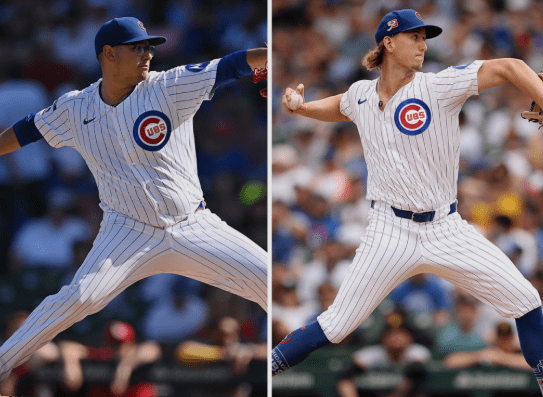
In that vein, I’d like to introduce a false choice involving the Cubs: Javier Assad or Ben Brown. While it is very possible that neither or both could be on the 26-man roster when the season opens, I’m going to pose the question with the assumption that there is only one roster spot available for the two of them – and that they are fighting it out this Spring for that spot.
While they are both right-handed, they have somewhat different arsenals: Assad uses six pitches, relying primarily on a sinker, using a cutter and then fourseamer as his secondary pitches, mixing in an occasional slider and curveball, and rarely using his changeup. Brown has been mostly a 2-pitch pitcher, using a fourseamer and knuckle curve, with a very rare changeup. Although, he appears to have added a sinker to his arsenal this season.
The other primary difference between the two pitchers is that Assad has been relatively successful, while Brown has struggled with his results. But if we dive into the numbers, things might not be so cut and dried.
First, lets looks at the number that favor Assad:
| Pitcher | ERA | bWAR | BABIP | LOB% | HR/9 | *Soft% |
|---|---|---|---|---|---|---|
| Assad | 3.43 | 5.1 (331 IP) | .279 | 81.1% | 1.09 | 16.8% |
| Brown | 5.12 | -0.7 (161.2 IP) | .323 | 66.2% | 1.28 | 12.1% |
*Soft% = percentage of batted balls against that were considered soft contact
With and ERA over a run and two-thirds better, and a +5.8 WAR according to Baseball Reference, you would have to conclude that Assad is a much better pitcher. And the other numbers show why. He allows fewer home runs and other hard hit balls and is much better about prevent the runners that he allows on base to score.
But let’s take a look at some other numbers:
| Pitcher | xERA | FIP | fWAR | SIERA | K/BB | K/9 | FB Velo |
|---|---|---|---|---|---|---|---|
| Assad | 4.77 | 4.46 | 2.7 | 4.68 | 1.99 | 7.37 | 92.3 |
| Brown | 4.43 | 3.75 | 2.4 | 3.49 | 3.63 | 10.30 | 96.0 |
These number suggest that Assad has been very lucky and that Brown very unlucky so far in their careers. Brown has almost 4 mph more on his average fastball, and despite have a much higher ERA, he has a much better FIP and SIERA that Assad. Just writing that statement feel like it would make my younger self’s brain explode.
There is no argument that Assad has been a much better pitcher than Brown, and past performance should be measured by results. This is why we see such a variance in the WAR provided by Baseball Reference (bWAR – which is more based on results) and the WAR provided by Fangraphs (fWAR – which relies more on peripherals in an attempt to be predictive).
With double the innings, Assad should have twice the WAR of Brown. He has this and more according to Baseball Reference WAR, based on the outcome or their pitching. However, based on how they have pitched, Fangraphs’ algorithm believes that Brown is more valuable.
Ultimately, whether you prefer Assad or Brown comes down to some very debatable elements of analytics verses history, and what is truly predictive for future performance.
Is the lower LOB% and BABIP that Assad has posted truly sustainable?
Here are the active pitchers with the best LOB% who have thrown over 300 innings:
| # | Name | K/9 | LOB% | ERA | xERA |
|---|---|---|---|---|---|
| 1 | Paul Skenes | 10.83 | 83.7% | 1.96 | 2.59 |
| 2 | Josh Hader | 14.56 | 82.3% | 2.64 | 2.48 |
| 3 | Javier Assad | 7.37 | 81.1% | 3.43 | 4.77 |
| 4 | Andrew Abbott | 8.33 | 81.0% | 3.42 | 3.79 |
| 5 | Bryan Abreu | 12.23 | 80.7% | 2.65 | 3.40 |
| 6 | Shota Imanaga | 8.24 | 80.7% | 3.28 | 3.66 |
| 7 | Shane McClanahan | 10.14 | 80.3% | 3.02 | 3.63 |
| 8 | Edwin Díaz | 14.54 | 80.0% | 2.82 | 2.43 |
| 9 | Kenley Jansen | 12.40 | 79.9% | 2.57 | 2.60 |
| 10 | Jacob deGrom | 10.82 | 79.6% | 2.57 | 2.81 |
| 11 | Jason Adam | 10.48 | 79.5% | 2.69 | 3.23 |
| 12 | Shohei Ohtani | 11.41 | 79.5% | 3.00 | 3.15 |
| 13 | Kirby Yates | 12.39 | 79.1% | 3.36 | 3.22 |
| 14 | Aroldis Chapman | 14.58 | 78.7% | 2.52 | 2.77 |
| 15 | Garrett Crochet | 11.64 | 78.6% | 2.95 | 3.00 |
| 16 | Raisel Iglesias | 10.63 | 78.2% | 2.90 | 3.09 |
| 17 | Josiah Gray | 8.89 | 78.1% | 4.84 | 4.66 |
| 18 | Gavin Williams | 9.20 | 78.0% | 3.54 | 4.25 |
| 19 | Ryan Pepiot | 9.31 | 78.0% | 3.54 | 3.78 |
| 20 | Brandon Woodruff | 10.52 | 77.9% | 3.10 | 3.17 |
Only 6 of the 20 have a K/9 under 10, and Assad is the only one under 8. This makes some sense, as a strikeout is typically the best way to get out of a jam.
In looking over the past 50 years, looking for pitchers with over 1000 innings, there was only one player over 80% LOB — Mariano Rivera. HIs K/9 is surprisingly low, at 8.22.
If we drop the innings limit to 500, a few more names show up: Hader, Billy Wagner, Armando Benitez and Francisco Rodriguez – all closers with over 10 Ks/9. The outlier is Darren O’Day, who had a 83.2% LOB%, and a 9.41 K/9. But he was another reliever and had over 2 strikeouts per nine innings more that Assad.
Here the Sabermetrics/Fangraphs definition of LOB%: https://library.fangraphs.com/pitching/lob/
From the article:
“Most pitchers have LOB%s around league average (which is approximately 70-72%, depending upon the season), and pitchers that deviate from that average tend to see their numbers regress towards average in the future. In other words, if you see a pitcher with a 60 LOB%, they are letting lots of runners score so their ERA will be high, but the odds are that they will strand more runners in the future and lower their ERA.
Not all pitchers will regress toward league-average, though: high strikeout pitchers have been shown to have some control over their LOB%. Pitchers that record a high numbers of strikeouts can pitch their way out of jams more easily than pitchers that rely upon their team’s defense, so they are able to maintain LOB%s higher than league average. Also, if a pitcher isn’t a major-league caliber starter — or if they’re a borderline case — it’s likely that their true-talent LOB% is below league average.”
That would seem to be bad news for Assad.
Next, we will take a look at BABIP:
https://library.fangraphs.com/pitching/babip/
“BABIP is likely even more important when evaluating pitchers because they have almost no control over what happens to a ball once it is put in play. A pitcher can control their strikeouts, walks, and home runs, and through those, the number of balls they allow to be put into play, but once the ball leaves the bat, it’s out of their hands. As a result, pitcher BABIP is heavily influenced by defense and luck, which means the number of hits a pitcher gives up is influenced by things outside of their control. And if hits are somewhat outside of a pitcher’s control, so will their runs allowed totals.
This is a long way of saying that pitchers with a high BABIP are most likely victims of poor defense or bad luck, and neither is the pitcher’s fault. Their defense might be attached to them, but their luck is not, meaning that we typically expect most pitchers with extreme BABIP values to regress toward league average going forward.”
So again, as strike against Javier Assad.
For Ben Brown, the opposite is true. Fielding Independent Pitching or FIP is often seen as one of the best predictive statistics: https://community.fangraphs.com/a-brief-analysis-of-predictive-pitching-metrics/
“FIP does a better job of predicting the future than measuring the present, as there can be a lot of fluctuation in small samples. It is less effective in describing a pitcher’s single game performance and is more appropriate in a season’s worth of innings. That doesn’t mean it isn’t a retrospective statistic, simply that it requires more than a handful of innings to be a reliable indicator of performance, just like any statistic.”
Another pitcher stat that attepts to remove fielding where Brown is better than Assad is SIERA: https://library.fangraphs.com/pitching/siera/
Brown was 20th in MLB for pitchers with over 100 innings, and the list of other players in that grouping is very impressive:
| # | Name | SIERA |
|---|---|---|
| 1 | Tarik Skubal | 2.71 |
| 2 | Zack Wheeler | 2.73 |
| 3 | Garrett Crochet | 2.86 |
| 4 | Logan Gilbert | 2.86 |
| 5 | Chris Sale | 2.88 |
| 6 | Cristopher Sánchez | 3.02 |
| 7 | Hunter Greene | 3.06 |
| 8 | Paul Skenes | 3.10 |
| 9 | Logan Webb | 3.14 |
| 10 | Nathan Eovaldi | 3.17 |
| 11 | Sonny Gray | 3.29 |
| 12 | Spencer Schwellenbach | 3.30 |
| 13 | Bryan Woo | 3.30 |
| 14 | Yoshinobu Yamamoto | 3.32 |
| 15 | Jacob deGrom | 3.32 |
| 16 | Joe Ryan | 3.32 |
| 17 | George Kirby | 3.39 |
| 18 | Hunter Brown | 3.39 |
| 19 | Jesús Luzardo | 3.40 |
| 20 | Ben Brown | 3.52 |
| 21 | Nick Lodolo | 3.57 |
| 22 | Dylan Cease | 3.58 |
| 23 | Max Fried | 3.60 |
| 24 | Framber Valdez | 3.66 |
| 25 | Jack Flaherty | 3.67 |
| 26 | Freddy Peralta | 3.68 |
| 27 | Nick Pivetta | 3.69 |
| 28 | Edward Cabrera | 3.72 |
| 29 | Ranger Suárez | 3.73 |
| 30 | Trevor Rogers | 3.75 |
So, when announcers say that the analytics love Ben Brown, this is what they are talking about.
I suppose one pitcher we can point to who seemed to defy the analytics was Kyle Hendricks. He had a career 73.2% LOB% and .283 BABIP, with a 7.08 K/9, even lower than Assad. And those career numbers were negatively affected by the last three seasons, wend a slight decrease in velocity negatively impacted his numbers. He had over 80% LOB% in 2016, 2017 and 2020 with relatively low strikeout numbers.
Brett Taylor of Bleach Nation compared the two (and noted some differences) in 2024: https://www.bleachernation.com/cubs/2024/09/08/assads-years-of-success-and-swing-ability-shaw-and-mervis-dingers-davis-slump-and-other-cubs-bullets/
One attribute that Hendricks had that could not be argued was his mental fortitude. He was thoughtful in the way he attacked hitters, and he would not give in – walking players as opposed to giving them great pitches to hit on favorable counts. But this is an attribute that is very difficult for the analytics world to wrap their collective heads around. It takes a large sample set of data to identify outlier players, and even then, there is no real evidence to prove causation.
But it is possible that Javier Assad has a mental makeup that will allow him to sustain some of these numbers that are generally not predictive. And for Ben Brown, perhaps he will never find the success that his underlying numbers are predicting that he should have.
Personally, I think both pitchers have value, and expect both to get a significant amount of time on the Cubs roster this season. As for which will perform better…your guess is a good as mine.
 Cubs in 7
Leave a comment