

As the news about the financial struggles of the Marquee network come to light, some Cubs fans (myself included) are wondering if this will impact spending on free agents going into the 2026 season.
I think it’s fair to say that every sports fan thinks the team they root for – including college teams now – are not spending enough on players. But that is not always a fair assessment, as there are financial constraints that teams must be conscious of.
But for the Cubs, I think the criticism has been fair. They are one of the most valuable teams in Major League Baseball, but seem to spend on payroll like a mid-market team. This was not always the case in the Ricketts era, but it definitely has been true the last several seasons.
It is the prerogative of the Ricketts fail to spend what they want on payroll – within the confines of the Collective Bargaining Agreement. But within that structure, there are advantages given to small-market teams to help with competitive balance. And if the Cubs are not using their financial advantages, they are actually putting themselves at a competitive disadvantage.
So first let’s take a look at how much the Cubs are making versus how much they are spending on payroll. Here is the current list of the value of MLB franchises from Forbes:
https://www.forbes.com/sites/justinteitelbaum/2025/03/26/baseballs-most-valuable-teams-2025/
| Place | Team | Value | *Operating Income/Loss |
|---|---|---|---|
| 1 | New York Yankees | $8.2 Billion | -$57 Million |
| 2 | Los Angeles Dodgers | $6.8 Billion | +$21 Million |
| 3 | Boston Red Sox | $4.8 Billion | +$120 Million |
| 4 | Chicago Cubs | $4.6 Billion | +$81 Million |
| 5 | San Francisco Giants | $4.0 Billion | -$24 Million |
| 6 | New York Mets | $3.2 Billion | -$268 Million |
| 7 | Philadelphia Phillies | $3.1 Billion | +$9 Million |
| 8 | Atlanta Braves | $3.0 Billion | -$3 Million |
| 9 | Houston Astros | $2.8 Billion | -$11 Million |
| 10 | Los Angeles Angels | $2.75 Billion | +$40 Million |
| 11 | St. Louis Cardinals | $2.55 Billion | +$7 Million |
| 12 | Texas Rangers | $2.45 Billion | -$38 Million |
| 13 | Seattle Mariners | $2.2 Billion | +$43 Million |
| 14 | Toronto Blue Jays | $2.15 Billion | -$60 Million |
| 15 | Washington Nationals | $2.1 Billion | +$0 |
| 16 | Chicago White Sox | $2.0 Billion | -$41 Million |
| 17 | San Diego Padres | $1.95 Billion | +$32 Million |
| 18 | Baltimore Orioles | $1.9 Billion | +$65 Million |
| 19 | Athletics | $1.8 Billion | -$23 Million |
| 20 | Milwaukee Brewers | $1.7 Billion | +$24 Million |
| 21 | Arizona Diamondbacks | $1.6 Billion | –$33 Million |
| 22 | Detroit Tigers | $1.55 Billion | +$30 Million |
| 23 | Minnesota Twins | $1.5 Billion | +$5 Million |
| 24 | Colorado Rockies | $1.475 Billion | -$22 Million |
| 25 | Cleveland Guardians | $1.4 Billion | +$11 Million |
| 26 | Pittsburgh Pirates | $1.35 Billion | +$47 Million |
| 27 | Cincinnati Reds | $1.325 Billion | +$29 Million |
| 28 | Kansas City Royals | $1.3 Billion | +$6 Million |
| 29 | Tampa Bay Rays | $1.25 Billion | +$32 Million |
| 30 | Miami Marlins | $1.05 Billion | +$38 Million |
*As reported by the teams
OK, so the Cubs are the 4th most valuable team in MLB. So are they spending on payroll like they are the 4th most valuable team? Here is a very popular chart attempting to show percentage of revenue that is going to payroll.
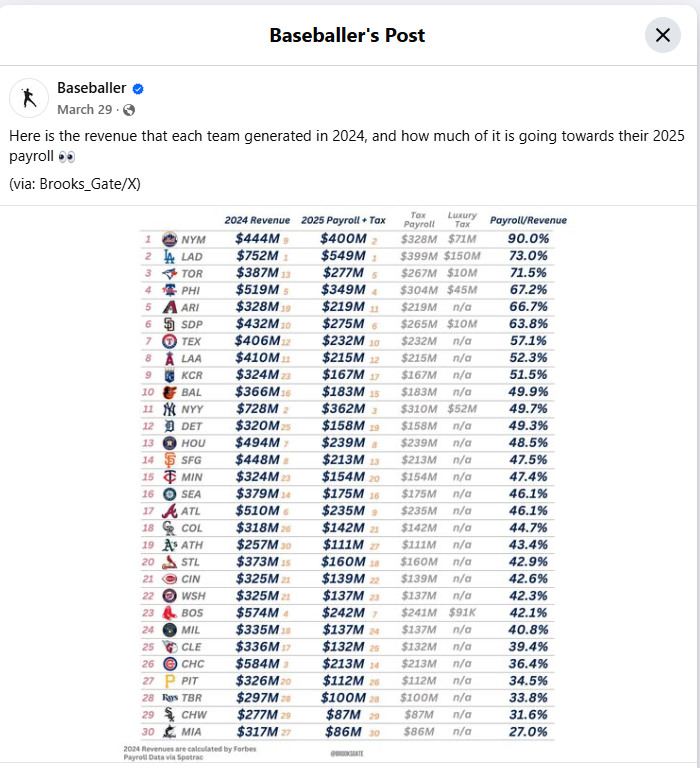
There are certainly issues with the chart, as there’s no real way to get an truly accurate number on revenue — Forbes is making a best effort to estimate. And this only accounts for payroll spending that is publicly available. Spending on all other baseball activities (and there are a lot) are not included.
But, it does provide one data point. And from this data point, the Cubs were 26th in payroll spending as compared to revenue.
Let’s take a look back at the evolution of the Cubs in the Ricketts’ era to see where they landed in terms of payroll. Sportract only goes back to 2011, so we’ll start there:
| Season | Payroll | MLB Place |
|---|---|---|
| 2011 | $137.7 Million | 6th |
| 2012 | $114.9 Million | 10th |
| 2013 | $103.2 Million | 14th |
| 2014 | $90.4 Million | 22nd |
| 2015 | $133.0 Million | 11th |
| 2016 | $186.8 Million | 5th |
| 2017 | $172.1 Million | 9th |
| 2018 | $194.3 Million | 4th |
| 2019 | $221.6 Million | 3rd |
| 2020 | $86.6 Million | 3rd |
| 2021 | $144.0 Million | 14th |
| 2022 | $151.0 Million | 17th |
| 2023 | $189.9 Million | 11th |
| 2024 | $231.7 Million | 7th |
| 2025 | $214.0 Million | 10th |
So, the team was in the top 5 in payroll 4 out of 5 years between 2016 and 2020. But they fell into the teens after the Hoyer rebuild, and have been 7th, 10th and 11th the past 3 seasons. I feel like the expectation of Cub fans would be to get into the 4-7 range every year, behind the Dodgers, Yankees and Mets, but ahead of teams like Philadelphia, Toronto, Houston, Texas and San Diego.
If Toronto can spend $40 million a year on Vlad Guerrero Jr. and $25 million a year on Dylan Cease, why can’t the Cubs spend the same on similar players? Or in the case of Cease, on that player?
For free agents over the past few year, let’s look at the top free agent the Cubs signed, and where that player placed on AAV comparatively among all free agents.
| Year | Player | AAV | Rank |
|---|---|---|---|
| 2012 | David DeJesus | $5 Million | t26 |
| 2013 | Edwin Jackson | $13 Million | t9 |
| 2014 | Jason Hammell | $6 Million | t40 |
| 2015 | Jon Lester | $25.8 Million | 2 |
| 2016 | Jason Heyward | $23 Million | t2 |
| 2017 | Jon Jay | $8 Million | t27 |
| 2018 | Yu Darvish | $21 Million | 3 |
| 2019 | Craig Kimbrel | $14.3 Million | t7 |
| 2020 | Steven Souza | $1 Million | t110 |
| 2021 | Joc Pederson | $7 Million | t39 |
| 2022 | Marcus Stroman | $23.7 Million | 8 |
| 2023 | Dansby Swanson | $25.3 Million | 8 |
| 2024 | Cody Bellinger | $26.7 Million | 4 |
| 2025 | Matthew Boyd | $14.5 Million | t29 |
Again, between 2015 and 2018 the Cubs got some of the biggest free agent names on the board. But there were other years where they barely dipped their toes in the free agent pool. They won’t be able to get a Michael King, Framber Valdez, Alex Bregman, Eugenio Suarez or Kyle Schwarber if they are not willing to spend in the top 10 for a free agent this off-season.
There are concrete examples from just the last off-season of specific times the Cubs were not willing to spend, when they could have improved the team:
- The inability to get Alex Bregman in 2025 – while Matt Shaw had a decent season, having a player like Bregman in the lineup, especially in the playoffs, would have been a big boost. But even after getting an exception from the Ricketts to negotiate with Bregman, the front office was given only enough resources to be outbid.
- Salary dumping in the Cody Bellinger trade – the Cubs got pennies on the dollar for Bellinger because they refused to eat more of his salary. The Yankees paid all but $5 million of the $32.4M owed (2025 salary and buyout), and their reward was that they got Bellinger for a non-prospect (Cody Poteet). The Cubs did not have room for Bellinger after acquiring Tucker, but if they had been willing to take on more of his salary, I’m guessing the might have gotten a decent prospect that would have softened the blow of what it cost to get Tucker.
- Unwillingness to go after one of the top-line pitchers in 2015 – While Boyd was good, having Max Fried would have been better. To be fair, injuries hit some of the other top-line free agent starters in 2025 (specifically Corbin Burnes, Blake Snell and Nathan Eovaldi), so it is possible the Cubs would have missed the playoffs if they had chosen one of those pitchers over Boyd. Or one of the other 11 starters who got paid more than Boyd, but were not nearly as good.
And then there is the unwillingness to go after Kyle Tucker this off-season. Sure, the close of 2025 was not great. But he has a unique skill set of power and on-base ability that is shared by a very small percentage of major league players.
At his point, we all assume they simply will not go after him, and he will sign somewhere else. But players like him do not come around often, and the Cubs should be able to afford at least one superstar player who is at the peak of their earning power. If not now, when? And if not Tucker, who?
 Cubs in 7
Leave a comment