
When a pitcher gets 2 strikes on a hitter, and the count is not full, one of the underappreciated skills is to put the right choice of next pitch in the right spot to try to get a strikeout. If the pitcher can get the hitter off balance, making the pitch look like it is a strike before tumbling out of the strike zone, or throwing a pitch the hitter is not expecting, it typically lead to a swing and miss, taking a called third strike or, at the very worst, fouling off the pitch or inducing weak contact.
But if the pitcher makes a mistake in the strike zone in those situations, the outcome can be catastrophic. We saw a couple of prime examples of this last night on the home runs the Brewers were able to hit.
Imanaga vs Vaughn
In the bottom of the first, Shota Imanaga had given up back-to-back singles when Andrew Vaughn came to the plate with 2 outs.
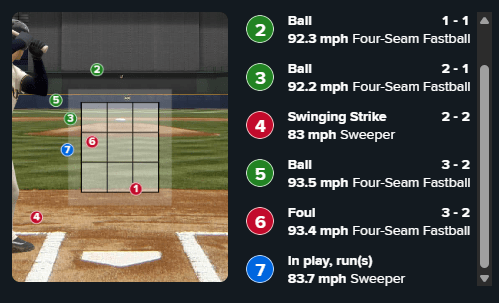
The count was 2-2 when he decided to throw a four-seam fastball up. The pitch was too far inside, and Vaughn took it for ball 3. If the pitch had been a bit closer to the zone or at the top of the zone, there is more of a chance Vaughn would have swung. There’s no guarantee that having the ball at the top of the zone would have resulted in a strikeout or an out put in play, but it seems like that placement was preferable to the middle of the zone vertically, where his last two pitches ended up.
All credit to Vaughn for taking an far inside pitch out of the ballpark, but it would suspect it would have been tougher to hit as hard if it had been higher or lower.
Palencia vs Chourio

This is the one that really hurt. While the offense did not end up scoring enough to counteract the William Contreras home run, this home run put the game out of reach.
After getting 2 outs, Palencia had hit a man and allowed a single to Joey Ortiz (his first ever hit in the postseason) putting runners on first and second. Chourio was late to the first two fastballs, and so Kelly called a third. I’m guessing it was supposed to be above the zone, to try to induce a swing and miss. But instead, it caught the middle of the plate, and he smashed it over the wall in center.
Again, you have to get the hitter credit for squaring up 101, but when the two previous pitches were of similar speeds in the same general vicinity, you can see how a major league hitter would be able to make solid contact.
I would have to go back and look at some of Palencia’s previous outings to see if this is a trend or a very unfortunate rarity. Wildness inside the strike zone with two strikes is something that seemed to hinder Porter Hodge and, in my opinion, is one of the reasons he did not make the postseason roster.
As a fan, there is almost nothing as frustrating as an 0-2 pitch that results in a hit by the opposition, making a home run in that situation exponentially worse. Perhaps the lack of contact with less than two outs and a runner at third is similar. Or getting picked off or thrown out on the bases when it is not going to be close.
But beyond the loss, the wat in which the Cubs gave up so many runs last night has left a very bad taste in my mouth, and the Cubs stand on the precipice of the 2025 season coming to an end.
 Cubs in 7
Leave a comment