
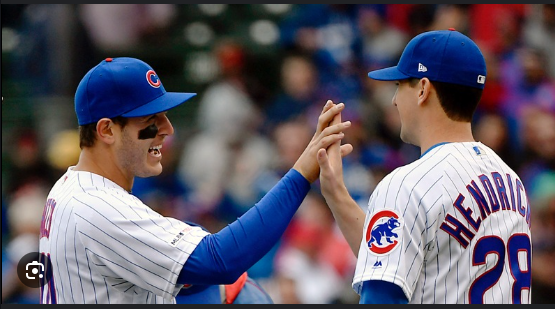
Rizzo was the first big piece in the Theo Epstein/Jedd Hoyer rebuild of the Cubs, and along with Kyle Hendricks, had the best long-term tenure of any of the members of the 2016 World Series winners. Ultimately, he might be judged to have had the best career of anyone from that magical season.
The ending is a bit sad, but very few players’ careers end on a high note. Injuries cut short the denouement of his playing days, and it appears he was unwilling to play the game of minor league contracts in his final year. But now that he’s decided to call it quits, he can come back to Wrigley and be treated like the hero that he was.
I wrote about the rebuild years, and the trade that brough Rizzo to Chicago for Andrew Cashner. It was not viewed as a slam-dunk at the time, as Rizzo had struggled in a brief stint with San Diego, and Cashner looked like a solid starting pitcher. But 10-years later, after the Cubs had traded Rizzo to the Yankees, they had won a World Series title, had 3 NLCS appearances, and had acquired a decent prospect in Kevin Alcantara. The Padres got 5 seasons of Cashner, who accumulated only a 0.8 WAR. He was flipped with a couple prospects for a trade that included Luis Castillo and Josh Naylor, but neither did much for the Padres, and they we subsequently traded in deals that netted the Padres very little.
One interesting thing about Rizzo is that he only led the position players in WAR twice for the Cubs, but he was almost always in the top 2 or 3:
- 2012 – Darwin Barney 4.2 – Rizzo 2.2
- 2013 – Wellington Castillo 4.0 – Rizzo 2.5
- 2014 – Rizzo 5.6 – Luis Valbuena 2.5
- 2015 – Rizzo 6.4 – Kris Bryant 5.4
- 2016 – Kris Bryant 7.3 – Rizzo 5.8
- 2017 – Kris Bryant 5.7 – Rizzo 4.7
- 2018 – Javy Baez 6.8 – Rizzo 3.1
- 2019 – Javy Baez 6.7 – Rizzo 4.4
- 2020 – Jason Heyward 1.6 – Rizzo 1.0 (COVID year)
- 2021 – Willson Contreras 4.2 – Rizzo 1.3 (traded mid-season)
He was overshadowed by Kris Bryant and Javy Baez for a few years, but maintained a level of consistency – both with his performance and health – that eluded several other Cubs. Excluding his first season and the last two abbreviated seasons with the Cubs, Rizzo played 150 or more games 5 times, and over 140 the other two. While his final seasons with the Yankees were marked by injury issues, he was almost always out on the field for the Cubs. And his OPS+ was above 100 for every year he played for the Cubs.
Rizzo also was great defensively, winning 4 gold gloves at first base. He made 3 All-Star Games and received MVP votes 5 times, finishing as high as 4th in 2015 and 2016. And while his overall number in the playoffs were not great (slashing .225/.328/.397 for the Cubs and Yankees), he had an OPS over 1.000 in the 2016 NLCS and World Series.
There were some bad feelings between Rizzo and the Cubs, as his contract was coming to his end. He signed a very team-friendly deal in 2013 for $41 million over 7 years. He was definitely underpaid over the, but that is the risk a young player takes when deciding accept the security of a long-term deal. That had to be on his mind when he turned town a 4-year $60M offer and then a 5-year $70M proposal from the Cubs. It’s odd to consider he would be in the final year of the 4-year deal, if he had accepted it. Instead, he signed for the Yankees for $33M for two years, and then a 1-year $17M deal with a $6M buyout for 2025. So he ultimately made only $56M over 4 years, which is less than he would have earned from the Cubs “lowball” offer.
After re-signing with the Yankees, he said he had no regrets, but I wonder if that is still the case: https://www.nbcchicago.com/news/sports/mlb/chicago-baseball/ex-cubs-1b-anthony-rizzo-no-regrets-over-declining-extension/2789355/
In a season mixed with lots of success and some failure on the field, the loss of an icon in Ryne Sandberg, and the return of Sammy Sosa, bringing Rizzo back to be honored should serve as a bright spot as we close done the regular season, and hopefully head toward the playoffs.
 Cubs in 7
Leave a comment