
Well, actually, I’d describe Out of the Park Baseball – which is the “video game” I’ve been playing for several years — as more of a simulation than a game. While being lots of fun, it has also taught me a lot a lot about running a major league baseball team.
I was someone who has played some kind of baseball simulation for much of my life. Like Theo Epstein, I started out with MicroLeague Baseball (https://en.wikipedia.org/wiki/MicroLeague_Baseball) on the Commodore 64, and got hooked. The core game was pretty pedestrian — it contained rosters of some of the great all-time teams, which I would run in tournaments, watching the simulated games and writing down the results in a notebook. I never was too keen on playing manager — I just liked to see what was going to happen.
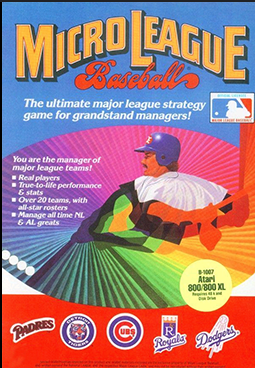
Everything changed when I ordered the GM and owners disk and box score and stat compilers disk. These add-ons allowed me to input my own teams (I did not bother purchasing any of their season disks, as I could just input all the stats myself). My heyday was taking the 1987 player data and doing an 8-team roto-style draft, inputting the real player data for those teams, and then acting as the GM for all of them simulating games.
Of course, there were lots of limitations. There was no left/right split adjustments for hitters or pitchers. There were no defensive stats. And the system only used past stats to determine future results, and could not handle small sample sizes, so plyers like Bill Schroeder, who slashed .332/.379./.548 in 270 ABs in 1987 was a superstar. And there was no computer general manager AI, so I had to be a GM for every team.
Despite all of these shortcomings, the game still provided me with hours of entertainment. Although I was always envious of the advanced features of the Amiga version of the game, like rain delays and fights.
There was an arcade baseball game for the C64 called Hardball (as seen in the movie, “The Princess Bride”) I played. And then after getting a PC, I dabbled with games like Earl Weaver Baseball and Tony Larussa baseball in the 90s, which had better graphics and simulation capability, but never provided as much fun.
In the early 200s, I discovered Out of the Park Baseball. It reminded me of a much better MicroLeague, but I didn’t have a much time to play – and did not play many baseball sims again until Baseball Mogul in the mid-2010s.
But I rediscovered OOTP in 2020, and my enjoyment of baseball simulations has returned l. It was developed by a German baseball lover, and has provided me with all the tools needed to fulfill my dream role as a GM for the Chicago Cubs.
The game has lots of feature I will never use, such as playing other Leagues around the world. And the detailed settings are mind boggling. But I stick to being GM of the Cubs, running several simulations of the current season at the beginning, and then running one league for extended seasons. I leave the managing to the computer manager (which has left me very frustrated — especially during a few playoff games).
The level of detail in certain aspects has helped me better understand the challenges of a major league GM. Here are a few examples:
-Roster Management – there is an accurate active and 40-man roster, so tough decisions need to be made around who makes the team, and when you want to DFA a player. Sometimes you can sneak a player though waivers and send them back to the minor leagues, but most veteran players refuse and you must release them (and eat their contract)
-Financial Constraints: the system provided financial constraints provided by the owner that act like a salary cap (sound familiar, Cub fans?). You must navigate that when adding players via trades and free agency
-Good computer AI for trades – this is one that is very difficult to program, so while there are a few head-scratchers, the system typically does a good job of making sure trades are fair. Half-season rentals are definitely a thing, just like in real life.
-Injuries – this is an unfortunate part of the game, just like reality
-A “live start” feature that allows you to pick up a season in progress with all the current “real world” records, stats and injuries
-A realistic draft and international signings period to help build your team
-Very detailed ratings (offensive, defensive and pitching) with hitting and pitching profiles
-Somewhat randomized potential ceilings for prospects, as well as ratings changes for current players as they age and get injured. This makes every simulated season different, and can lead to wildly different outcomes
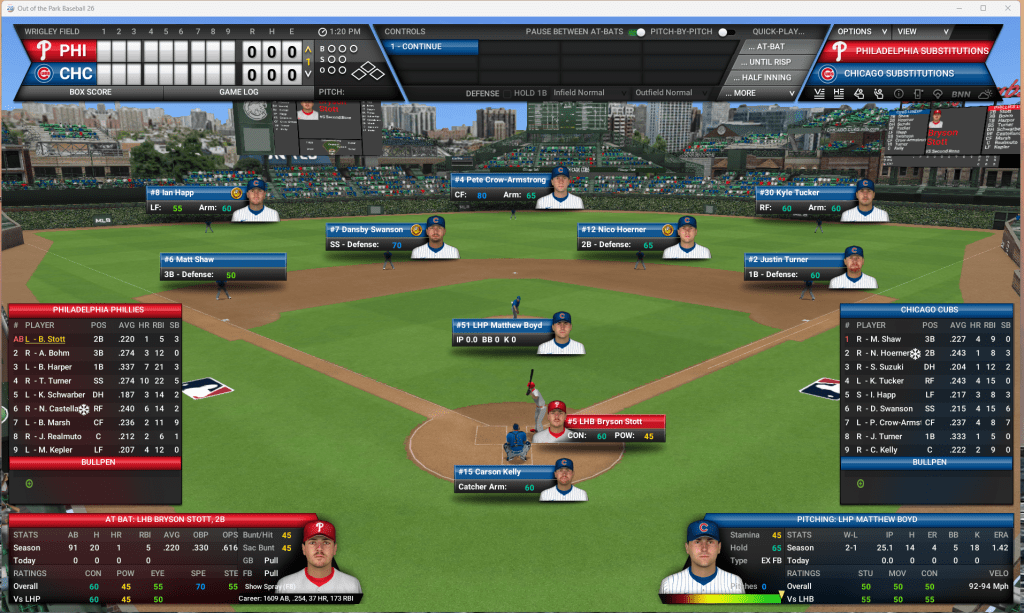
-Watching simulated games has decent graphics (although I’d love to have them partner with an engine like MLB the Show to watch the games they simulate -which would never happen), and it’s easy to skip ahead to a more interesting part of the game – which is essential if you’re not managing every inning.
So, overall, as a simulated GM, I can get lots of enjoyment trying to get my team to the playoffs and beyond. I change the settings so that I don’t have to worry about concession and ticket prices, and I don’t worry about managing my minor league affiliates.
I ran several quick simulations for this season, and most made it to the playoffs. There were a few nightmare season, but overall things bode well for the Cubs. Of the 10 simulations I ran, I was unable to win a championship in any of them, making the World Series once, but flaming out in the Wild Card round most times.
There was no a huge amount of wheeling and dealing most years — I picked up Framber Valdez in a couple of the simulated 2025s. JT Realmuto came available on year, when my catchers were performing quite badly. And there were season ending injuries for both Justin Steele and Shota Imanaga on a couple of occasions.
I’ve decided to start running the franchise over multiple seasons, starting with the Tokyo games, and it’s been a bit rough with a record at 12-16 as we get through the gauntlet of April. I lost Steele for a couple of weeks, and Julian Merriweather for a month. Porter Hodge was sent down due to ineffectiveness, and many of the hitters (Suzuki, Hoerner, BUsch, Happ and Swanson have and OPS+ under 100. Although Matt Shaw has played well enough to keep the job at third. Ryan Pressly got of to a rough start, but seems to have righted the ship. The rest of the bullpen has been good (including Pearson and Morgan) and Brasier came back to replace Hodge. Colin Rea has been disappointing as a long reliever with a 7.00 ERA in 7 games.
I’ll provide more updates as the season progresses.
 Cubs in 7
Leave a comment